
Overview
High-quality dictation with full confidentiality.
A panel of speech recognition models, fused by a language model, on a server we run ourselves rather than in the cloud.
What Diane is
Diane is a dictation app for words you would not want to leave the room.
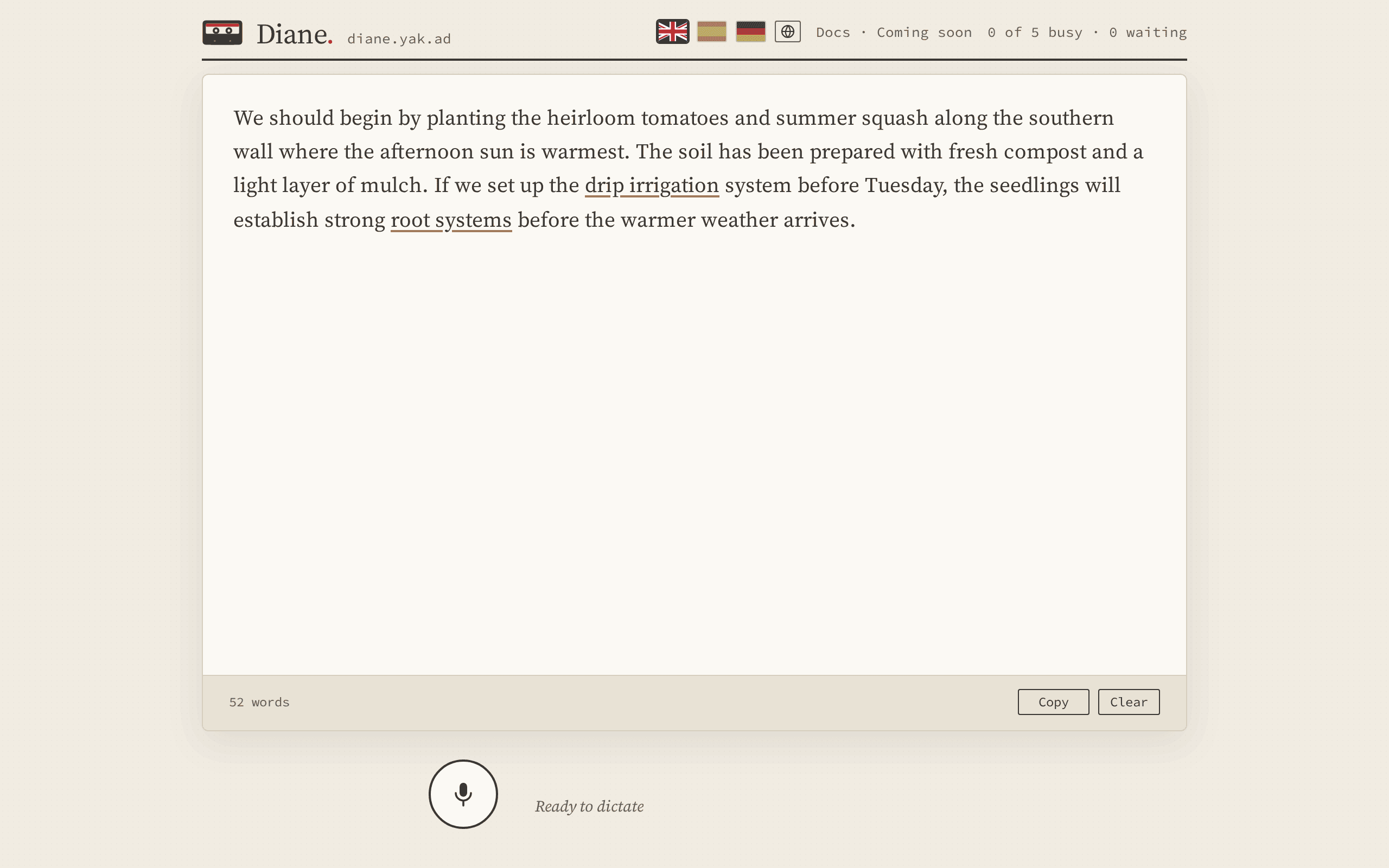
As you speak, Diane transcribes live. A grey draft appears within seconds and is refined as you go. When you press stop, the final, polished text replaces it a couple of seconds later. Punctuation and capitalisation are handled for you.
Under the hood, Diane is not one speech model. It runs a panel of speech recognition models on the same audio, and a language model fuses their outputs into a single transcript, picking the best reading of every phrase. That is why the quality is noticeably better than any single model on its own.
Diane works in 26 languages: English, Bulgarian, Catalan, Croatian, Czech, Danish, Dutch, Estonian, Finnish, French, German, Greek, Hungarian, Italian, Japanese, Latvian, Lithuanian, Polish, Portuguese, Romanian, Russian, Slovak, Slovenian, Spanish, Swedish and Ukrainian. Tap the globe in the top-right corner to add up to three to the header, then turn on the ones you speak. With two or more on, Diane detects which one you're speaking at the start of each dictation.
Why confidentiality matters
We believe that very soon most of our interaction with software will be by voice. But voice is about as personal as data gets, and many companies building applications are not comfortable sending their users' audio to servers in another country, run by someone they can't audit.
So there is real demand for dictation that is both high quality and genuinely confidential, especially from businesses, and very little supply. There are individual users too: people who care about privacy and choose the app with the strictest confidentiality policy.
Diane's server is not in a big cloud data centre. It is a small server in our office, set up physically and in software for privacy. Your audio travels there over an encrypted connection, gets transcribed, and the text comes back to you. No recordings and no transcripts are kept on the server after the text reaches you. To plan capacity, it counts anonymous usage statistics with no IP address (see Confidentiality).
Where it's going: from promise to proof
Today, "we don't keep your audio or your text" is a promise, backed by a self-audited server configuration (see Confidentiality). We want to turn it into a technical guarantee.
- Confidential computing. The plan is to run the whole pipeline inside confidential computing hardware: a confidential virtual machine on an Intel TDX or AMD SEV-SNP processor, together with a Blackwell-generation NVIDIA GPU with confidential computing. Memory is encrypted by the hardware, the traffic between the CPU and the GPU is encrypted, and not even the operator of the server can look inside.
- Remote attestation. Before your app sends a single second of audio, it checks a signed attestation from the hardware proving exactly which code is running. You don't have to trust us; you can verify it.
- On-premise kit. For enterprises that want full ownership: the same setup delivered as a kit, so a company runs the entire dictation pipeline end to end inside its own walls.
What comes next
Beyond confidentiality, we are building in these directions:
- Integrations into the apps people already write in, like Microsoft Word and Google Docs.
- Meeting transcription, with who said what and when.
- Adaptation to your voice: training that adapts to each user's own voice and vocabulary, so recognition is tailored to how you speak.
- Switching language mid-dictation (in development).
The first version gets the quality right, and to us that is table stakes. We think that in a few years the keyboard will mostly be there to fix the occasional mistake. Everything else will come from your voice.